 |
|


|
|
What to do and what not to do with casts! 1.Do not walk on it if instructed to “non-weight bear”. The cast may break and cause loosening of the metalwork applied at surgery. 2.Do not get it wet. While the outer layer may be spray proof the inner lining of cotton will get soaked and may get the wounds infected. If plastic bags and tape do not work for you search for “waterproof cast covers ” on the Internet 3.Do not poke instruments to scratch the skin inside the cast. 4.Keep the foot elevated. This will reduce the swelling and prevent the cast from getting too tight 5.Move your toes and knee whenever possible to keep up good circulation What are “Back slabs” and why are they applied after some surgeries? Back slabs are half casts which form a hard splint at the back of the ankle and is soft over the front half to allow for some stretch needed to accommodate the tissue swelling which is expected over the first day or two after surgeries. After usually 48 hours it is changed to a full cast, when the risk of acute swelling is minimal. However elevation is important to prevent the swelling from recurring around the foot and ankle. Do not weight bear through a back slab as it is not strong enough and may break. What are the possible complications due to a cast and are there any warning signs? 1. Blisters or pressure sores – These are uncommon complications. They could occur at the edges of the cast from chafing because the cotton padding has shifted or got wet and damaged. Pressure sores at the heel or front of the ankle are rare and occur when there is unexpected swelling within the cast, making it excessively tight. It may follow accidental falls while in the cast causing bleeding into the dressing and more swelling. Always inform your surgeon of any accidents while in a cast. “Fracture Blisters” result from rapid swelling and stretching of the skin following severe fractures and are not related to casts. 2. Blood Clots (Deep Vein Thrombosis- DVT) – The risk of DVT is very low after foot and ankle surgery except when there is prolonged immobilization in a cast making blood flow sluggish in the veins. Additional risk factors include a previous history of a blood clot, obesity, oral contraceptives etc.. All patients at risk will be given anticoagulation medication for the full duration of the cast. Warning signs – Excessive swelling or constant tingling sensation in the toes, bluish discoloration persisting in spite of elevation, unusual foul smell which could indicate wound infection, progressive pain not controlled with the prescribed pain medication. When is a removable splint applied? These appear like plastic ski boots and have a large front shell, with straps holding it to the main boot. The main advantage of these splints over casts is the fact that it can be removed when resting or sleeping and is required only for walking. And you can wash your feet!! They tend to have an inflatable lining, which consists of little air pockets to be inflated with a bladder, provided with the splint. 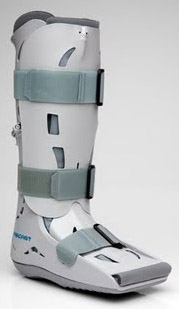 It helps achieve a snug fit.
It can be applied after minor fractures where there is minimal risk of displacement of the bone fragments or sprains. Following major surgery for fusion or osteotomies (bony cuts) it is important to keep the foot absolutely still in the initial weeks and therefore a cast is applied. However mid way through the healing process, if it has healed enough to allow weight bearing and needs only limited protection the cast is removed and replaced with a such a splint. It helps achieve a snug fit.
It can be applied after minor fractures where there is minimal risk of displacement of the bone fragments or sprains. Following major surgery for fusion or osteotomies (bony cuts) it is important to keep the foot absolutely still in the initial weeks and therefore a cast is applied. However mid way through the healing process, if it has healed enough to allow weight bearing and needs only limited protection the cast is removed and replaced with a such a splint.Most such splints have soles shaped like a "rocker" for easy walking. Why does my cast feel loose at times and tight at other times? Changes in the swelling around the foot and ankle cause the cast to feel loose or tight. Typically it would feel tight if the foot has been hanging low, especially in the first couple of weeks following surgery. Elevation will reduce the swelling and the cast will feel comfortable again. If there is a persistent feeling of tightness or swelling of the toes or pins and needles sensation in the foot, in spite of elevation contact your surgeon, as you may require a change of cast. A couple of weeks after surgery the cast tends to feel slightly loose as the post surgical swelling no longer occurs. If you feel that it is excessively loose and rubbing against skin when walking, contact your surgeon. How can I help when the cast is being applied or taken off? Casting: Try and keep your limb as still as possible. The foot in most casts needs to be held at a right angle to the leg and therefore pull the foot back to this position while the cast is being applied. A stocking is first applied followed by a layer of cotton and then the casting material. A thigh support will aid in holding the limb up in the air for casting. Inform the surgeon if there is any feeling of tightness. Removal: The saw blade oscillates and does not rotate like a circular saw. Therefore it cannot cut through skin if used appropriately. It’s growl is worse than its bite!! Two cuts are made to remove the cast like two shells. Help the surgeon by turning from side to side to allow easy removal. Has "Plaster of Paris" (POP) casts been completely replaced by synthetic ones? No. Although colourful synthetic casts are more widely used nowadays, POP casts are still needed in situations where careful moulding is needed. POP is like clay and can be shaped to hold the foot in certain exact positions. Sometimes both are combined with an inner layer of POP and outer synthetic reinforcement. |